
St Francis Of Assisi Catholic Academy Trust
Trust Impact
The Difference of Belonging
The very best Catholic education now and for generations to come.
St Francis of Assisi Catholic Academy Trust exists to deliver the very best Catholic education now and for generations to come.
Since our first schools converted in 2021, belonging to the Trust has made a measurable difference to the children, staff and communities we serve. This page draws together the testimony of our headteachers and the evidence of our schools - and it offers an honest answer to the question 'what benefits does being in the Trust provide pupils (and therefore parents), staff, schools and their wider communities’?
The answer is consistently: more expertise within reach, more capacity for leaders carrying heavy loads, more financial resilience, and more support – all leading to improved outcomes for pupils, excellence for all, the best quality Catholic education now and into the future, better experiences for staff and a stronger sense of belonging to a wider Catholic family.
Rising outcomes for children
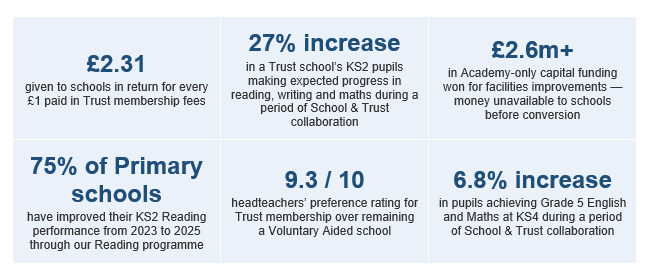
The clearest measure of our impact is what children achieve. For example, with Trust support at St Mary’s, our secondary school, the proportion of pupils achieving grade 5 and above in English and mathematics reached 65.9% in 2025 - well above the Hertfordshire average of 53% and the national average of 45%.
Progress scores have climbed from above average in 2023 to ‘significantly above average’ in 2025, placing the school inside the top few per cent in the country for the progress its pupils can make.
The same trajectory is visible across our primary schools, where shared moderation, collaborative curriculum work and a relentless focus on standards are lifting reading and writing outcomes year on year. 75% of our primary schools have improved their reading outcomes between 2023 & 2025. Schools that sat broadly at local-authority average now exceed it.
Eight of our schools have now been inspected by Ofsted, and every report acknowledges the contribution of the Trust to the school’s improvement.

A shared spiritual life
At the heart of everything we do is the spiritual life our schools share. Chaplaincy teams once working in isolation are now connected across the Trust, united by a common Trust prayer, Trust-wide liturgy and the pupil-designed St Francis chaplaincy badge. From the cross-phase Franciscan Values Award - running from the Early Years to Year 13 - to the Trust Carol Concert, Chaplaincy Retreats and Sacramental Gatherings, children of every age are given ways to live out the values that define us.
Belonging also widens children’s horizons, through shared sporting competitions, the Voice21 oracy programme, Trust-wide science and maths events, and more - often free of charge and with transport provided. For our smallest and most rural schools, these are experiences that would be impossible to provide alone.

Inclusion, and the children who need us most
The Trust’s investment in inclusion is felt most keenly by the children who need it most. Under our Trust SEND Executive Lead, schools share a resource bank, specialist interventions and a sustained programme of training - including support for children who have experienced trauma - that would be far beyond the reach of a single school. SENCo clusters, provision audits and a common SEND framework bring consistency and quality to provision for children with Education, Health and Care Plans. Even when facing the most complex and challenging circumstances, such as possible permanent exclusions, the Trust’s relationships with external agencies and legal advisers has given its leaders expert, steadying support through a very difficult time, which in turn enabled much improved outcomes for these vulnerable pupils.
Support and challenge for every school
Improvement in our Trust is built on a termly cycle of support and challenge. School Effectiveness Advisers and the executive team work alongside leaders to interrogate each school’s self-evaluation, sharpen its development plan and prepare for inspection. These conversations hold a mirror up to practice while ensuring that no school is left to face difficulty alone. When a dip in writing was flagged at one school, targeted moderation and support returned outcomes to trend; at another, early access to a pilot writing scheme strengthened teaching and lifted pupils’ pride in their work.
Growing and retaining brilliant staff
A trust of our size can offer staff opportunities that a single school cannot. The Executive Headteacher model has repeatedly provided stability when it is most needed, securing leadership, systems and the confidence schools need when navigating a change at the top. Trust-funded responsibility posts, leadership secondments, associate positions, NPQ pathways from middle leadership through to headship, and a structured programme for early-career teachers all help us develop and retain our staff. An internal HR team and external legal advisers carry the high-stakes matters that would otherwise rest on a headteacher’s shoulders alone.

A substantial — and clear — financial case
The financial case for belonging is substantial, and we are transparent about it. Across the first four years since conversion, our central finance team turned collective purchasing, shared expertise and Trust-wide oversight into £4.57 million of savings, offsetting £1.98 million in membership fees - a return of £2.31 for every £1 paid.
We are equally clear that joining a trust is a long-term strategic decision: the broader value of membership lies in the quality of school improvement that pupils and staff experience, arising from the support and services the Trust provides; the financial returns are in addition to this and build over time rather than arriving all at once.
The savings are real and varied - economies of scale on catering, cleaning, energy and software, rates relief, and the end of local-authority de-delegation. Above all, conversion unlocks capital. As academies, our schools can bid for Condition Improvement Fund grants that were unavailable to them as Voluntary Aided schools – we have won more than £2.6 million to date for major schemes that improve the facilities, safety and experience for pupils and staff.

Strong governance, especially when things are hard
Strong governance underpins everything else. Local governing bodies are supported through termly meetings with directors, annual executive visits, comprehensive induction and a clear scheme of delegation, anchored in the ethical standards of the Seven Principles of Public Life.
The clearest proof of this is what happens when things are hard: in one Primary School there was a need to help one Governing Body with a number of terms of appointment coming to an end at the same time. The Trust rebuilt an effective board through targeted and timely recruitment, CEO support and the loan of an experienced chair and governors from another Trust school for a fixed term whilst new governors were readied. As one of our Chairs of Governors put it: “Trust schools are not an isolated island; they are well supported when issues arise”.
What This Means for our current Pupils, Parents, Staff and other Schools Considering Conversion
Schools join our Trust from many different starting points - confident and thriving, or facing leadership change, financial pressure or governance difficulty - and in every case the experience has been one of being better supported, not less autonomous, and of benefitting from the Trust’s careful, collaborative and collegiate style. The local distinctiveness of each school is protected and strengthened rather than diluted, the benefits of membership compound over time, and no school is ever left to face its challenges alone.
Download the full report
Read the full Trust Impact Report
Our full report sets out the evidence in detail across the five pillars of trust quality: high-quality and inclusive education, school improvement, workforce, finance and operations, and governance and leadership